Azhimala Shiva Temple: Where the Arabian Sea Meets the Divine
A magnificent confluence of spirituality, mythology, sculpture and the Arabian Sea in South Kerala
THIRUVANANTHAPURAM, KERALA:
Where the waves of the Arabian Sea continuously embrace the rocky coastline and the endless horizon meets the sky, stands the magnificent Azhimala Shiva Temple, a unique spiritual and artistic landmark near Vizhinjam in Thiruvananthapuram district of Kerala.
Situated at Pulinkudi, close to the Poovar–Vizhinjam coastal route, the temple offers visitors an extraordinary experience where faith, mythology, nature and monumental art come together. The temple is dedicated to Lord Shiva and is particularly renowned for its imposing Gangadhareshwara sculpture, which has become one of the most recognisable Shiva landmarks of Kerala.
The Majestic Gangadhareshwara
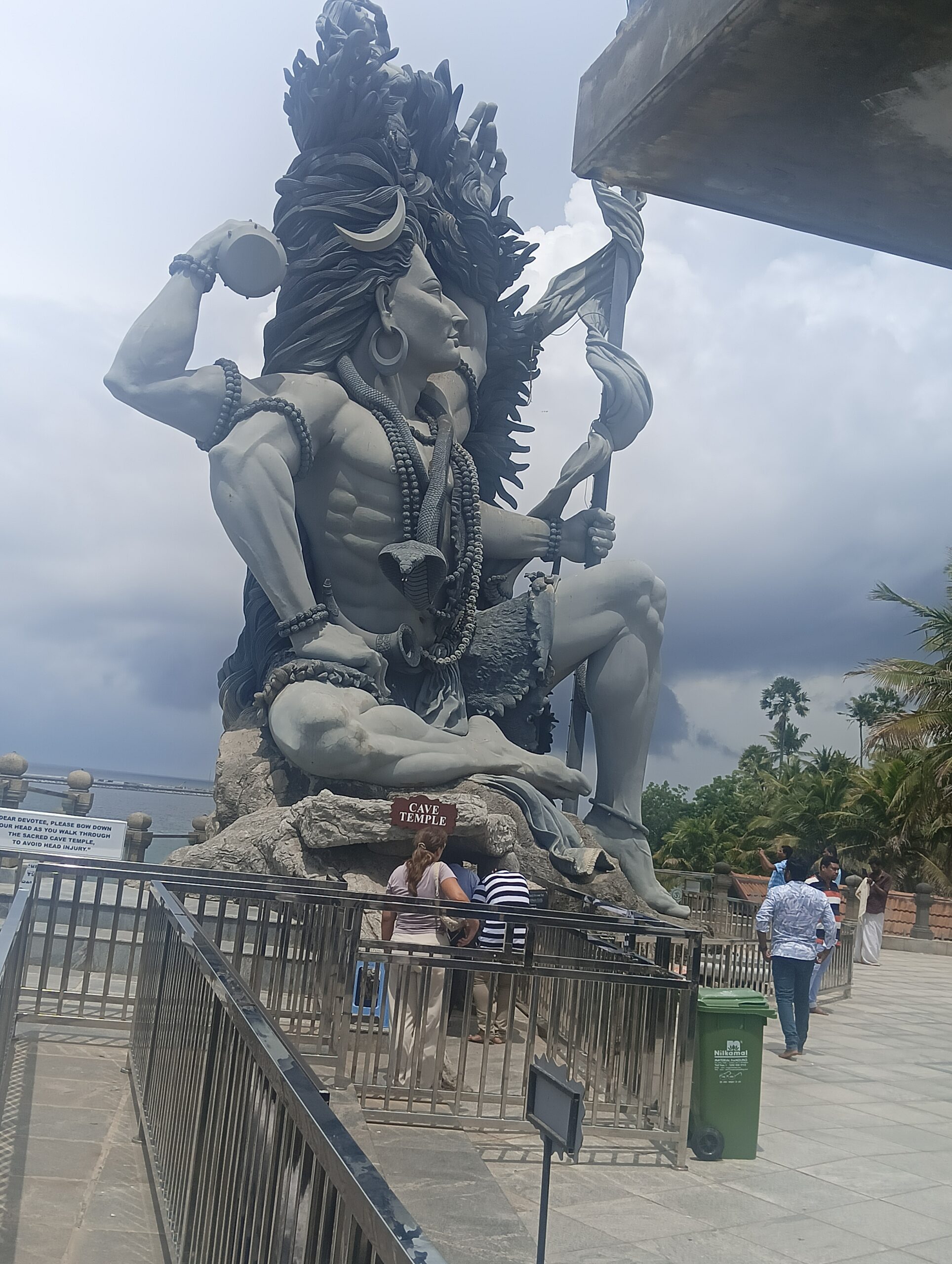
The first sight that arrests the attention of a visitor is the colossal image of Lord Shiva as Gangadhareshwara — the bearer of the sacred Ganga.
Standing majestically against the backdrop of the Arabian Sea, the approximately 58-foot-high sculpture portrays Lord Shiva in a powerful yet deeply contemplative form. His flowing matted locks, through which Goddess Ganga descends to earth, are rendered with remarkable artistic detail. The expression of Shiva, the contours of his body, the ornaments, the flowing hair and the divine posture together create an image of extraordinary visual power.
The sculpture was created by P. S. Devadathan, a native of Azhimala. Contemporary reports state that the young sculptor began the monumental work at the age of 23 and devoted approximately six years to its completion. The sculpture has been widely described as the tallest Shiva sculpture in Kerala and as a major Gangadhareshwara representation in India.
The setting makes the sculpture even more spectacular. Behind the divine figure stretches the vast Arabian Sea, while the sound of waves rising and breaking against the coast creates a natural symphony around the shrine.
A World of Shiva and Shakti Within the Cave
The splendour of Azhimala does not end with the monumental statue. Moving further into the temple complex, visitors encounter a fascinating cave-like spiritual and artistic space, where the stories and manifestations of Shiva and Shakti have been brought alive through sculpture and visual art.
The interior transports visitors into an evocative world of Hindu mythology. Among the most captivating depictions is the divine presence of Lord Shiva and Goddess Parvati, represented together in an intimate and graceful expression of divine companionship. The imagery evokes the eternal philosophy of Shiva and Shakti — the inseparable principles of consciousness and energy.
The cave further presents several powerful manifestations of the Divine Mother and Lord Shiva, including Mahakali, Bhadrakali and Kalabhairava. Each representation carries a distinct expression and symbolism, giving the visitor the feeling of moving through a living gallery of Shaivite mythology.
Nataraja and Ardhanarishvara
Among the artistic highlights are the magnificent representations of Lord Shiva as Nataraja, the cosmic dancer.
The Nataraja form symbolises the eternal rhythm of existence — creation, preservation and transformation. Through movement and expression, the sculpture conveys the philosophical idea that the universe itself is in a perpetual state of cosmic dance.
Another profound representation is Ardhanarishvara, the composite form of Shiva and Parvati. With the masculine and feminine principles united in one divine form, Ardhanarishvara represents the philosophical ideal of completeness, balance and the inseparable nature of Shiva and Shakti.
The cave also features representations of Shiva accompanied by his Ganas and Yoginis, adding further depth and movement to the artistic narrative.
A Temple Where Art Becomes Worship
What makes Azhimala particularly fascinating is that the artistic work is not merely decorative. Here, sculpture becomes a medium of spiritual expression.
The figures, expressions, postures and intricate details collectively narrate the vast world of Shaivite philosophy and mythology. For a visitor, the experience is less like walking through an ordinary gallery and more like entering a three-dimensional visual interpretation of ancient sacred narratives.
The temple’s architecture also carries a strong southern Indian influence, with colourful sculptures, traditional forms and artistic elements associated with the Dravidian temple tradition.
A Spiritual Presence Associated with the Temple
Within the artistic complex, visitors can also see a large statue associated with the spiritual personality whose inspiration and vision are connected with the development of the temple and its spiritual tradition.
This presence adds another dimension to the temple complex, linking its contemporary artistic expression with the spiritual heritage associated with Azhimala.
Where Nature Becomes Part of the Pilgrimage
Perhaps the most remarkable feature of Azhimala is its location.
The temple does not merely overlook the sea; the sea becomes an integral part of the spiritual experience.
The massive Gangadhareshwara appears to rise from the rocky landscape while the Arabian Sea stretches endlessly behind him. On one side is the immense power of nature; on the other, the timeless stillness of Lord Shiva.
At sunrise and sunset, the changing light transforms the entire landscape. The colours of the sky, the movement of the waves and the imposing silhouette of Shiva create a scene that is simultaneously spiritual and spectacular.
For pilgrims, it is a sacred destination. For travellers, it is a remarkable coastal attraction. For photographers and art lovers, it is an open-air canvas where sculpture and landscape merge into one unforgettable image.
A Unique Destination of South Kerala
Azhimala Shiva Temple has consequently emerged as an important attraction for visitors travelling through South Kerala. Its combination of a sacred coastal setting, monumental Shiva sculpture, mythology and elaborate artistic representations gives it a character distinctly different from conventional temple destinations.
The temple is located at Pulinkudi, Mulloor P.O., Thiruvananthapuram, Kerala – 695521. The temple’s official website lists its contact number as +91 471 2268422.
A visit to Azhimala is therefore not simply a temple visit. It is an encounter with a landscape where the ocean becomes the backdrop, the rocks become the canvas, sculpture becomes prayer and mythology comes alive through art.
Standing before Gangadhareshwara Shiva with the Arabian Sea behind him, a visitor experiences a rare synthesis of India’s spiritual heritage and contemporary monumental art.
Azhimala is, in every sense, a place where the eternal presence of Lord Shiva meets the infinite rhythm of the sea.